Reading Navigation
Inside the hidden field of non-clinical psychedelic practice
This series describes practice as it exists, including work that is illegal in some jurisdictions. It offers no medical, dosage or legal advice, and nothing here is an endorsement of unlawful practice.
PsyStandard seeks to publish its standard openly, as a reference anyone can learn from. Verification and membership are different: they apply only to practice within the law, and even there they reduce risk without removing it.
Non-clinical psychedelic practice takes place across Europe, openly and out of sight, yet nobody has defined or quantified its extent, and no shared standard covers it. This is the first part of a series on why that needs to change.


1. The field nobody has counted
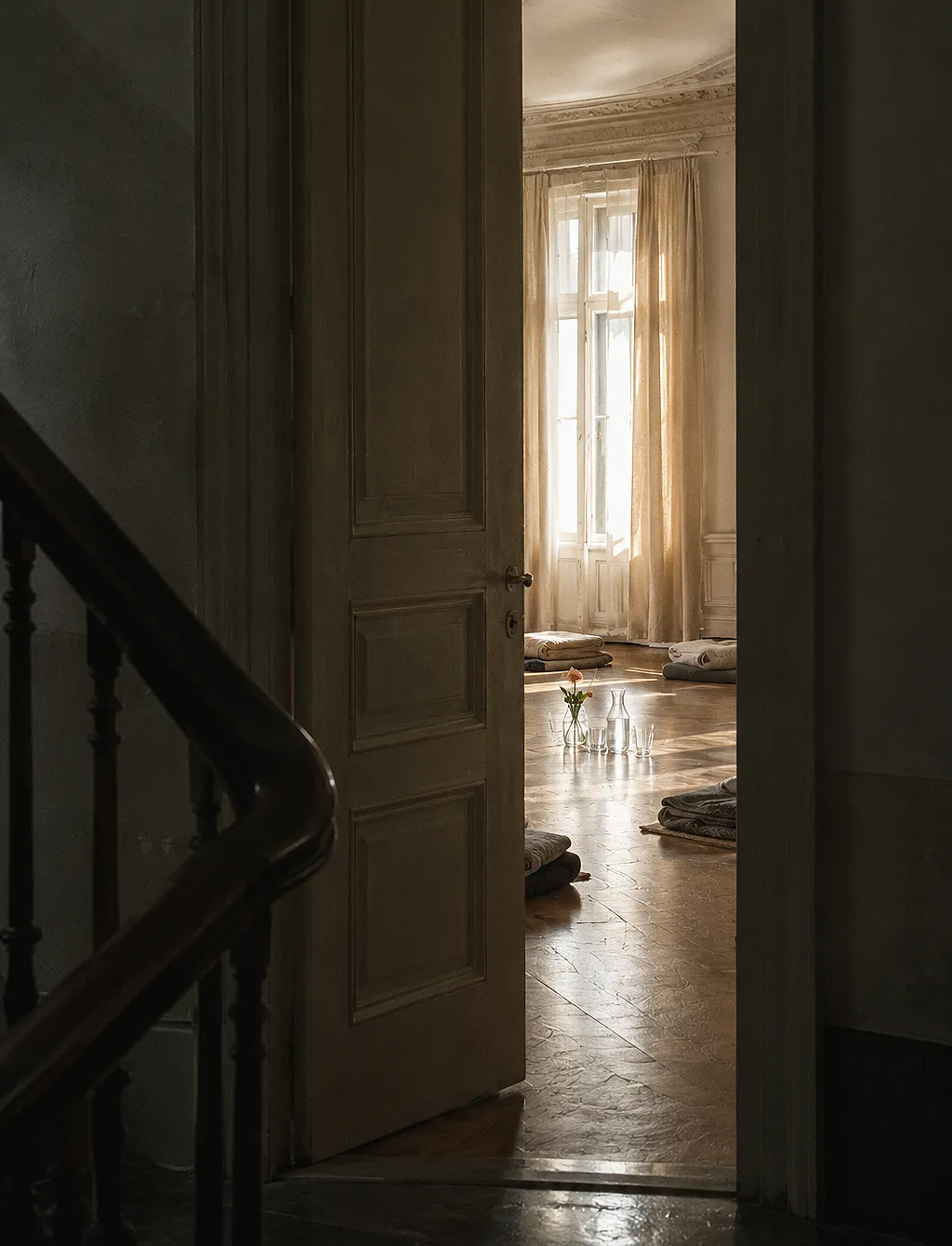
On a Saturday morning, two groups sit down to begin a psychedelic weekend: one in a high-ceilinged flat in a German city, behind a door with no sign on it, the other in a farmhouse in the Dutch countryside, booked through a website with star ratings and a cancellation policy. They operate in different legal worlds and do much the same work.
Neither appears in any statistic. Europe measures how many people use psychedelics, while who sits with them, how those practitioners trained and what they do when something goes wrong go unrecorded.
The field has no agreed definition either. Its practitioners describe themselves as coaches, integration specialists, ceremony leaders or space holders, and where one role ends and another begins varies between countries and training, so any count would first have to decide on definitions and what to count. For this series, non-clinical practice means work outside licensed medical and psychotherapeutic settings, such as preparation, integration, group work and retreats, some of which is legal and some of which is not. A standard means a published, shared set of criteria against which practitioners can be assessed, developed through co-design with the people it applies to.
This series moves from the field itself to what makes a psychedelic setting safer, how competence can be shown, what surrounds practitioners once their training ends, and what licensing did to practitioners in two US states. It starts with the field because a standard can only be set for a field that can be seen.
This piece offers no medical, dosage or legal advice and endorses no illegal activity.
2. Two rooms, one gap
Both rooms are anonymised composites drawn from the field in general, and neither describes a real practitioner, venue or client.
The flat
The group in the German flat has met before. Each participant went through a long screening conversation with the practitioner and a preparation process lasting several months, so by the time the weekend begins they know each other and the group’s agreements, and a strong practitioner–client bond has formed. There is an emergency plan, a psychiatrist participants can contact afterwards, and a practitioner who stays in touch for weeks after the weekend ends. The relationship itself carries much of the safety.
Everything that depends on visibility is missing: insurance, open supervision, honest advertising and any way to report an adverse event. Calling an ambulance in an emergency would expose everyone present. With no website or listing, people arrive by word of mouth, and the practitioner’s skill, however real, can be judged only by those inside the circle.
The retreat
The Dutch retreat is legal, because psilocybin truffles can be sold in the Netherlands and truffle ceremonies operate as an open market. This one has a polished website and good reviews. Preparation consists of an online intake form and a short call, participants meet each other and the team on arrival, and the weekend centres on the experience itself. Integration amounts to a closing circle on Sunday, since no lasting relationship has been built that could carry more.
The retreat is visible yet unmeasured. In the Netherlands, the title of truffle ceremony leader is unprotected and training is optional: in a May 2026 investigation by the regional broadcaster Omroep Brabant, journalists who interviewed 10 ceremony leaders in one province found courses ranging from eight days to 10 weekends spread over a year. A sector association, the Guild of Guides, has around 35 members and works on voluntary guidelines that no retreat is required to follow (Hoeks & Kösters, 2026).
What the rooms show
The pattern could as easily run the other way, since some Dutch retreats spend months on preparation and some underground groups do none. Depth of care follows the practitioner and the relationship, which makes legal status a poor indicator of either safety or skill.
Skilled and careless practitioners work in both rooms. The law makes the underground practitioner impossible to check, while legal room makes the Dutch retreat easy to book and no easier to judge, so from the outside a client has no way to tell them apart.
3. What we can measure, and what we can’t
Europe does collect data on psychedelic use. According to the European Drug Report 2026, last-year use of hallucinogenic mushrooms among young adults (aged 15 to 34) remains low in most countries, with rates above 1% including the Czech Republic (2.7%), the Netherlands (2.5%) and Germany (1.2%, aged 18 to 34), all from 2024 surveys (European Union Drugs Agency, 2026).
These surveys record whether someone used a substance and leave open where, with whom and who was holding the space. Their headline figures also centre on young adults, while practitioners will recognise that many people who come to them for integration, couples work, or questions of grief and the end of life are older; national breakdowns up to the age of 64 exist, but they too measure use alone.
The agency is candid about these limits, noting that current monitoring performs poorly at picking up patterns and trends for these substances, which makes it hard to speak with confidence about their use or related harms (European Union Drugs Agency, 2026). We know of no European country that keeps a register of non-clinical practitioners, retreats or participants.
The Netherlands, where retreats operate openly, is the obvious place to test this. The same Omroep Brabant investigation identified 20 places offering truffle ceremonies in a single province. Dr. Michiel van Elk, an associate professor of psychology at Leiden University who has studied truffle ceremonies for years, told the broadcaster that their quality is currently neither controlled nor regulated, and described findings that cut both ways: many participants feel somewhat better afterwards, while some report more stress, low mood or emotional instability (Hoeks & Kösters, 2026).
A small number of retreats have hosted outcome research. One study of retreat participants, led by researchers at Imperial College London, found that rapport between participants and the retreat team helped predict lasting changes in wellbeing (Kettner et al., 2021). Studies like this describe what happens to participants without capturing the size of the sector, and beyond them the only figures come from retreats’ own marketing.
Underground practice is unmeasured by definition, and its public traces are mostly court cases and the rare practitioner willing to speak openly. The result is a field that can be described but not quantified, and so learns little from its own experience.
4. Where the attention goes
Seen from inside the field, attention flows mostly towards the clinical and pharmaceutical route, where psilocybin is being tested as a potential licensed medicine. That route matters, and it is slow and expensive by design: according to a 2021 review in Frontiers in Psychiatry, phase 3 clinical trials often cost hundreds of millions of dollars and take many years to complete (Rucker & Young, 2021).
Outside that route, practical experience accumulates every weekend, held by practitioners who are skilled, careful and unrecorded, and who in our experience appear in writing about psychedelics mainly when something goes wrong.
Dr. James Rucker and Professor Allan Young of King’s College London set out the clinical case against paid retreats: that they use early trial results to support claims those trials were never designed to make, and that no convincing evidence shows a retreat to be safer than standard harm reduction advice. The experience outside the clinic is real, and so is the risk of unchecked claims; a shared standard is one way to address both.
5. Who they serve, and what they know
The people who seek out non-clinical practitioners vary widely. Some are preparing for an experience or integrating one from years ago, some want mentoring around personal development, and some live with long-standing emotional difficulties and want therapeutic work outside a medical frame. Others come as couples looking for relational work, face grief or the end of life, or look for ceremonial and spiritual context.
Many have no clinical alternative, because trials enrol carefully selected groups of patients (Rucker & Young, 2021) and the routes open now remain relatively narrow, while others prefer a frame that does not begin with a diagnosis.
The knowledge and experience many practitioners have is harder to evaluate, because so little of it is documented. Dr. Friederike Meckel Fischer, a physician and psychotherapist who ran psycholytic individual and group work in Zurich for around a decade before her arrest in 2009, is one of the few underground practitioners to have told her story openly. In an interview with the Chacruna Institute, she described a structure developed herself and never published: health checks before anyone joined, a doctor present in every group, emergency equipment in the house, a long round of intentions before each session, and regular talk sessions before and after. She is equally open about what it failed to catch: some clients had personality disorders she did not recognise, and she had not looked closely at the conflict between a couple in the group. When one partner left the other, the person left behind reported the group to the police, who kept it under surveillance for a year before the arrest. Asked what would help others in her position, Meckel Fischer said, “It would be wonderful to have an underground association,” suggesting a place where practitioners could at least talk to each other (Capps, 2021).
In September 2009, a month before Meckel Fischer’s arrest, a doctor and psychotherapist in Berlin held a psycholytic group session with 12 participants, using a method that is not scientifically recognised in Germany. Six of them agreed to take MDMA, which, by the doctor’s own account, had been measured out on a malfunctioning scale, and two died of multiple organ failure despite emergency treatment (Bundesgerichtshof, 2011). In 2010, a Berlin court convicted the doctor of bodily harm resulting in death, imposing a sentence of four years and nine months and a permanent ban on practising as a doctor or psychotherapist in private practice (Ärzte Zeitung, 2010). The following year, the Federal Court of Justice overturned the verdict and ordered a retrial, ruling that because the participants had taken the drug knowingly, the facts established supported at most a conviction for negligence (Bundesgerichtshof, 2011).
Set side by side, the two cases share one weakness. Meckel Fischer built her structure on her own, and it held for around a decade until a conflict she had not examined brought it to an end; the Berlin session failed on what the doctor described as a faulty scale. In both, every safeguard depended on one person, with no one outside the room to check what that person might miss.
6. Why a standard has to start here
Returning to the scenarios visited in the introduction, neither room is covered by a shared standard: the legal Dutch room has voluntary guidelines for those who choose them, and the German underground room has none.
A standard gives everyone the same reference point. A client in either room can ask the same questions: How were you trained? Who supervises your work? What happens if something goes wrong? A practitioner in either room can hold their work against criteria that someone else can check.
Next week’s piece turns to what makes a psychedelic setting safer.
For now, most of the field remains out of view, and the question for everyone who works in it is how to bring its knowledge into the light without putting practitioners or their clients at risk.
Sources
Ärzte Zeitung. (2010, May 10). Haftstrafe für Drogen-Arzt [Prison sentence for drug doctor]. https://www.aerztezeitung.de/Wirtschaft/Haftstrafe-fuer-Drogen-Arzt-220833.html
Bundesgerichtshof. (2011). Beschluss vom 11. Januar 2011, 5 StR 491/10 [Decision of 11 January 2011, 5 StR 491/10]. https://www.hrr-strafrecht.de/hrr/5/10/5-491-10.pdf
Capps, R. (2021, July 28). LSD in the house, cops at the door: A psycholytic therapist reflects on her darkest moment. Chacruna Institute. https://chacruna.net/a-psycholytic-therapist-reflects-on-her-darkest-moment/
European Union Drugs Agency. (2026). Other drugs: The current situation in Europe (European Drug Report 2026). https://www.euda.europa.eu/publications/european-drug-report/2026/other-drugs_en
Hoeks, S., & Kösters, C. (2026, May 7). Geen controle op truffelceremonies: ‘Veel mensen denken: ik kan dit wel’ [No oversight of truffle ceremonies: ‘Many people think: I can do this’]. Omroep Brabant. https://www.omroepbrabant.nl/nieuws/6008331/geen-controle-op-truffelceremonies-veel-mensen-denken-ik-kan-dit-wel
Kettner, H., Rosas, F. E., Timmermann, C., Kärtner, L., Carhart-Harris, R. L., & Roseman, L. (2021). Psychedelic communitas: Intersubjective experience during psychedelic group sessions predicts enduring changes in psychological wellbeing and social connectedness. Frontiers in Pharmacology, 12, 623985. https://doi.org/10.3389/fphar.2021.623985
Rucker, J. J., & Young, A. H. (2021). Psilocybin: From serendipity to credibility? Frontiers in Psychiatry, 12, 659044. https://doi.org/10.3389/fpsyt.2021.659044