Reading Navigation

What is psychedelic intervision, and why do psychedelic practitioners need it?
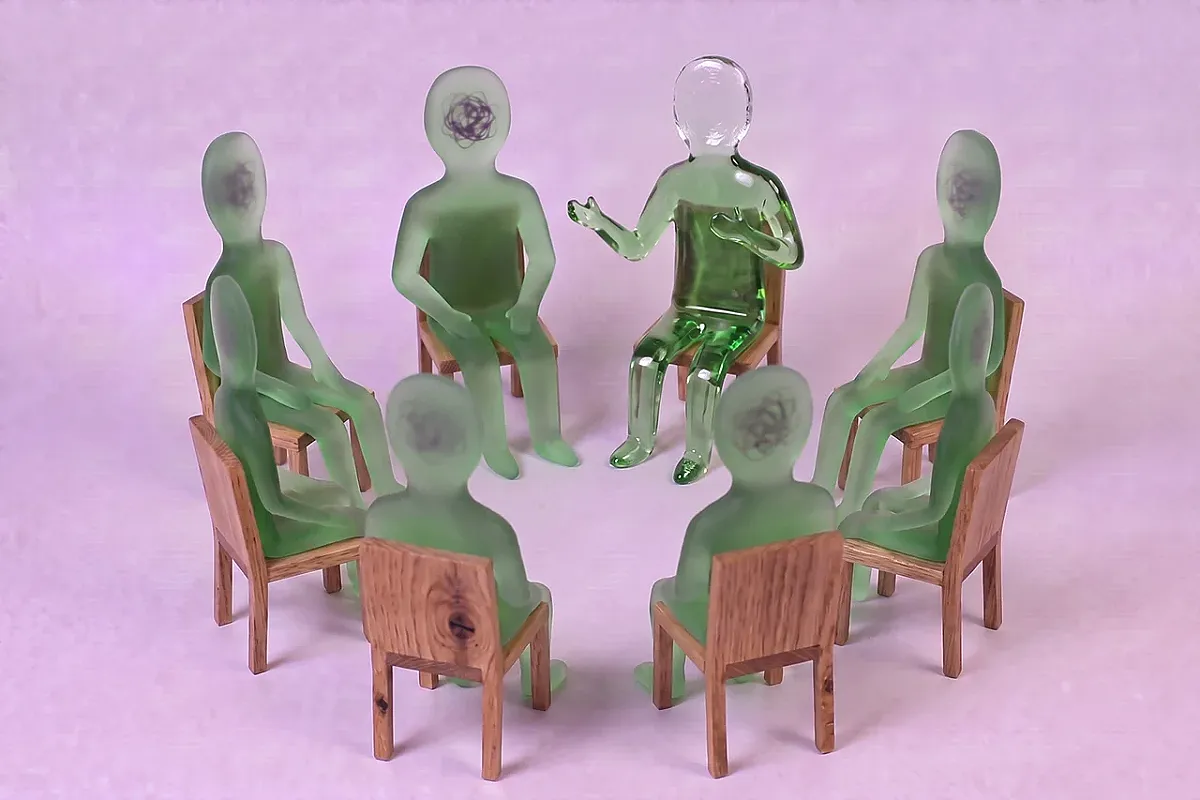
In a field where most practitioners work alone, unregulated, and with clients who are in a substantial and suggestible altered state of consciousness, psychedelic intervision, or ongoing peer-to-peer reflection, is closer to essential infrastructure than a simple nice-to-have. Ultimately, however sound one’s own therapeutic perspective, framework or positionality, neither you nor your clients may be able to see your own blind spots. Peers can.
Key takeaways
- Psychedelic intervision is structured, peer-led group reflection, distinct from supervision, personal therapy, and informal debriefs, where practitioners process their own responses to spaceholding work and surface blind spots that clients and solo self-reflection can’t reach.
- Altered states raise the ethical stakes. Increased suggestibility, intensified transference, and power dynamics between practitioner and client make peer accountability structures more necessary in psychedelic work than in most other therapeutic modalities.
- Without psychedelic intervision, practitioners risk developing unexamined bias, subconscious patterns and burnout: documented harm in the field tends to cluster around unexamined practitioner ego rather than the substances themselves.
- PsyStandard’s recommended intervision format offers a concrete five-stage structure (presentation, clarifying questions, reflection, response, and transfer) alongside standards for anonymisation and client consent that most facilitators currently lack.
- Effective intervision requires deliberate design: heterogeneous group composition, decolonising practice, and long-term trust built through consistency, not just good intentions.

1. What is intervision?
In the context of therapeutic spaces, intervision refers to structured, collaborative, peer-led, non-judgemental spaces to discuss complex situations, ethical boundaries, and personal-professional challenges. Through these sessions, practitioners, therapists, integration coaches, and psychedelic facilitators regularly meet to exchange experiences, review cases, and process or reflect on their own psychological responses to spaceholding work and the inevitable ethical conundrums it can elicit. Notably, intervision groups are usually non-hierarchical, with rotating roles held around an agreed method, collective agreement and code of conduct within the group.
While intervision is not a substitute for a practitioner’s own personal development and professional therapy – which enables them to continue working with their own psychological material -, the repeated group process can be invaluable towards assessing and revising one’s own conscious or subconscious biases and positionality. Ultimately, this process helps improve both the safety and efficacy of practice for practitioner and client alike.
Interestingly, the word intervision is largely absent from English vocabulary, although it is commonly used in German and Dutch professional culture (kollegiale Beratung). Intervision, or peer-to-peer reflection, as mentioned throughout this article, is usually co-managed within a group of interested individuals, and is a commonly agreed free or financially accessible practice, with the objective of collectively improving knowledge and practice quality.
2. Intervision vs supervision in psychedelic practice
Intervision differs from supervision, which is more of a hierarchical relational dynamic, where one individual usually holds a relevant qualification and carries responsibility for the reflection back onto the individual they are working with. Supervision is usually a paid-for service, and often requires a professional body. Importantly, intervision is not simply a financially accessible substitute for supervision and serves a different purpose entirely. There are specific situations which require professionals who carry clinical responsibility, and the two should never be conflated. Post-session group debriefs are also valuable, but they are different, and usually less structured, practices.
Key functions of intervision
- Case conceptualisation: Review preparation, dosing contexts, and integration strategies with experienced colleagues.
- Ethical guidance: Navigate delicate relational issues like transference, countertransference, power dynamics, and consent.
- Emotional support: Process the secondary strain and intense vulnerability unique to guiding individuals in altered states of consciousness.
“Intervision gives me somewhere to process my own experience of facilitating, not just the client’s. Making sense of what happened in a session comes through hearing how others read the same moment in an open, non-judgemental setting.” – Jessika Valentine, Consultant Clinical Psychologist
The practice of structured peer reflection has a much longer lineage than any single Western clinical body, however within psychedelic-assisted therapy specifically, organisations like the Swiss Medical Association for Psychedelic Therapy (SÄPT), which was founded in 1985, developed peer structures for legally authorised psychedelic therapists. They now offer a model of psychedelic intervision, as part of their specialised three-year PAT training programme, offered and continuously adapted since 2018. That’s a clinical training context, for physicians and psychologists, rather than a template for non-clinical practice to copy directly, although it shows how deliberately the structure can be built. Other formats exist under different names: Kylea Taylor’s InnerEthics Model, for instance, guides peer consultation groups through specific self-supervision and ethical-awareness tools. Taylor herself describes peer work as essential rather than optional; she is, in her own words, “a strong advocate of peer supervision: small groups of professionals who commit, in an ongoing way, to… explore ethical issues and their own fears and desires with trusted peers,” calling on formal supervision only when necessary.
3. Why does intervision specifically matter in psychedelic work?
Given psychedelic-assisted therapy and non-clinical psychedelic facilitations intense involvement of emotional breakthroughs, non-ordinary states of consciousness, and complex relational dynamics, intervision functions as a safety and quality-control mechanism, not just a professional-development nicety. As interest in PAT grows in both clinical and non-clinical contexts, the demand for, and importance of, group-based intervision work is increasing significantly, as more complex cases and situations arise that could benefit from peer perspectives.
Intervision helps practitioners develop hands-on experience managing therapeutic relationships and the complex, bespoke ethical considerations associated with altered states, including increased suggestibility, informed consent and touch, power dynamics and boundary transgressions, transference and countertransference. This raises a practitioner’s awareness of their own therapeutic responsibility and ethical exposure, while maintaining professional boundaries without withdrawing emotional availability from the client. Equally, it cultivates an open feedback culture and stimulates continuous professional development, acknowledging that many ethical dilemmas don’t have clean answers, but honouring that ongoing dialogue, peer support, regular supervision, and lifelong learning are the response to that, not a one-time training.
Intervision also fosters a co-created space for participants to ask each other what their intention was behind a specific response or action, to discuss feedback, and to evaluate the relative merits and drawbacks as a collective. Kylea Taylor’s InnerEthics model offers a specific version of this question worth borrowing directly: before intervening in a client’s process, ask simply “Who is this for?”, since the desire to be seen as the healer, the guide, or the catalyst for someone’s transformation isn’t wrong in itself, only when it goes unrecognised.
There are cases where psychedelic intervision may be particularly useful, for example those that involve complex shame, including attraction between a client and practitioner, in either direction; touch, and how consent for it was established, before and during an altered state of consciousness experience; dual relationships, including friendships and business ventures that grew out of client work; asking the client for testimonials or exchanges instead of clear and boundaried payment; discounts offered to keep someone returning; and clients whose medication, history or diagnosis sits beyond competence.
4. What happens without intervision?
Intervision is not simply a nice-to-have option for the reflective psychedelic practitioner. If peer-to-peer intervision is continuously omitted, practitioners are at risk of embodying maladaptive patterns – for example, entrenched power dynamics, subconscious bias, or exclusions – without a peer structure in place to identify and surface these tendencies. Even more subtly, practitioners can fall into the malpractice of projecting their own interpretation onto a client, rather than holding space for that individual to work it out themselves.
Regarding the safety of the practitioner, group support for the intensive spaceholding they offer matters for long-term sustainability, and reduces the risk of burnout. Collectively, the process aims to inspire practitioners to keep learning from one another, in a safe and supported container, encouraging curiosity and exchange rather than a calcification of fixed habits and practices that detract from the needs of individualised, personalised care. It can also help prevent practitioners from falling into a saviour framing, or the guru-isation of “their method”.
As there’s currently no harm register for the psychedelic field, this can’t be stated as a statistic, however documented incidents of harm in psychedelic and therapeutic spaces frequently have a practitioner’s ego attached to them, potentially more than the substance itself. Examples include sexual boundary violations framed as healing; vulnerable clients being recruited into a teacher’s worldview or facilitators working beyond their training scope. It’s a pattern worth naming plainly: frequently, it isn’t the pharmacology of the medicine that is the problem, it is the individual holding the space.
Given psychedelics’ ability to increase suggestibility and idealisation of the person guiding, a client’s judgement may be at its weakest exactly when the practitioner’s authority is at its strongest. This is a prime environment for insidious power dynamics to manifest.
Across the European landscape, psychedelics are heavily regulated by their pharmacology, although, despite the burgeoning nature of the field, there is minimal regulation of the relational side of practice. Alongside supervision and personal therapy, psychedelic intervision is one of the structures that sits in that gap, and it is the one most practitioners can actually access.
5. What psychedelic intervision looks like in practice
There are many ways and techniques to practise peer-to-peer psychedelic intervision, and these include the creation of vignettes and case studies for group discussion. Formats can vary: guided discussion of curated literature, letting participants explore a topic from multiple perspectives and expand their sense of their own positionality. Members of the group can also share techniques they employ or have developed, or collectively practise established experiential techniques such as body scans, mindfulness practices, self-regulation or visualisation exercises.
The PsyStandard psychedelic intervision format
As mentioned, psychedelic intervision is increasingly employed by groups such as SÄPT and other training organisations like the Experiential Training Institute, although each recommended format will have different guidelines. While there is not one correct approach, PsyStandard‘s recommended format for psychedelic intervision groups suggests the following structure:
- Presentation, 10 minutes. Presenter describes the case and states one question. They should remain uninterrupted through the process.
- Clarifying questions, 5 minutes. Questions should only be factual and advice should not be intertwined into a question.
- Reflection round, 15 minutes. Presenter steps back and listens while the group speaks about the case among themselves: hypotheses, associations, what they noticed in their own bodies while listening. The presenter stays silent and actively listens. This is the part most groups skip, and it is where the value sits.
- Response, 5 minutes. Presenter names what landed and what may, or may not, have been missed in their response to the situation in discussion.
- Transfer, 5 minutes. Each member says what they would do differently in their own practice.
Other core recommendations include mandatory anonymisation of the client and identifying details, alongside a firm rule to never change the therapeutically or relationally relevant material, because that content is what the group is reasoning with.
It is worth being honest about this rule’s limits, too: in a field this small and this networked, shared retreats, overlapping training cohorts, tightly connected professional communities, a case stripped of identifying details can still be recognisable. Anonymisation reduces risk; it doesn’t eliminate it, and groups should treat it that way rather than as a box ticked.
Consent deserves its own line here, because it’s a frequent gap in current practice. Clients should be told, in the contract or in preparation, that their material may be discussed anonymously in professional peer settings. Most facilitators in this field currently don’t do this. It’s a one-sentence fix, and exactly the kind of concrete standard this series should be known for.
The group’s questions, and its collective response to the scenarios raised, determine the quality of the outcomes. For example, “What should I do?” following a case presentation produces advice and competition. “What am I not seeing?” encourages the group’s actual function. Learning to formulate the second kind of question takes months, and is worth flagging as a skill rather than a formality.
6. Different perspectives as a mechanism to break positionality
Intervision groups are encouraged to be heterogeneous in demographic, ethnicity and background. Unsurprisingly, a group of practitioners from the same training, the same lineage and the same city may harmoniously confirm each other’s gaze and biases, and catch nothing. Homogeneous groups reproduce shared blind spots with great warmth. Based on this, groups can be ideally constructed considering:
- Mixed modalities and mixed training backgrounds.
- At least one member with clinical or psychotherapeutic training.
- Mixed genders, and awareness of who tends to speak first.
- At least one member outside your referral and business network.
It’s also worth naming directly, while a group can be structurally non-hierarchical on paper (e.g. rotating roles via an agreed method), it can still reproduce the very dynamic it exists to interrupt, if one member is more established, better known, or a source of referrals for the others. Composition has to account for status and dependency within the group itself, not only for overlap with clients outside it.
Importantly, many Indigenous peoples have practised these kinds of shared knowledge circles for millennia, and Western psychedelics intervision groups sit on a bridge between those traditions and the modern psychedelic field. Consciously applying decolonising practice matters here specifically, and it requires something more concrete than good intentions: a shift away from the Western medical default and toward community-led, culturally safe spaces that share power rather than concentrate it, and that respect Indigenous roots rather than simply borrowing from them.
In practice, that means horizontal leadership, where participants guide each other as equals rather than deferring to whoever holds the clinical credential in the room. It means treating personal and ancestral wisdom with the same seriousness as clinical science, rather than filing it under anecdote. It means naming, rather than quietly ignoring, how race, class, gender and colonial history shape a person’s mental health and their experience of these substances. And it means true reciprocity: finding real ways to support and give back to the Indigenous communities who protected these medicines and practices long before the western psychedelic field had a name for them, rather than treating that lineage as a raw material. Practically, that also means actively making room for queer, Black, Indigenous and other people of colour in these spaces, and creating enough cultural attunement to hold space for the trauma, oppression and lived history that can surface alongside the emotional and somatic material these sessions bring up.
7. Trust through consistency
Importantly, trust within these group dynamics is built consistently and repetitively, whereby a strong peer group is a function of repetition: same people, same time, same structure, over months, potentially years. Drop-in groups produce polite cases, where more complex patterns and subconscious dynamics may not unfold. Closed groups of a regular and prolonged format produce the material and reflections that change practice. Other elements of psychedelic intervision scaffolding may include:
- Fixed cadence. Monthly as a baseline, fortnightly as a preference. Same slot, protected like a client appointment.
- A commitment period, from six to twelve months, agreed at the start.
- Closed membership, with an explicit process for adding someone new, and an acknowledgement that each addition resets part of the container.
- A written agreement covering confidentiality, attendance, structure, and what happens when someone leaves. Signed, however informal it feels.
- Named roles: who holds time, who holds structure, who convenes.
The process of group familiarisation is also important to acknowledge. In many cases, for the first several months, peer groups may present tidy cases with satisfying endings. The difficult material arrives once people build trust in the collective and that frequently takes time.
Importantly, this scaffolding is an ideal to build toward, not a bar every practitioner can clear immediately. A twelve-month closed commitment and a protected fortnightly slot are far more achievable for a practitioner with institutional backing, financial stability, or an existing peer network to draw from, than for someone working solo, under-resourced, or geographically isolated. In reality, these structures shouldn’t quietly end up rewarding practitioners who already have the most support.
8. Intra-group dynamics and conflict
Importantly, the collective should aim to treat disruptions, whether in individual or group dynamics, as an opportunity for therapeutic growth and reflective insight, rather than just a problem to manage. A leaderless group is still a group with a structure, and someone has to hold time, sequence and the collective container in moments of tension. Rotating facilitation is the usual model, although it carries a cost: the facilitator of the day is also a peer with a stake in the room. Some groups may consider bringing in an external facilitator once or twice a year, which is a reasonable middle path and worth exploring.
Where conflict actually comes from in these groups:
- Status and rivalry, particularly when members compete for the same clients or retreat slots.
- Ethical disagreements, including one member’s practice that others consider unsafe.
- Someone repeatedly advises instead of reflecting.
- Someone using the group as their own therapy.
- Unequal disclosure, where one person brings real material and others never do.
What competent facilitation of conflict looks like, concretely:
- Slow the pace down and take one person at a time.
- Separate the case from the relationship, and address them in that order.
- An agreement made in advance that anyone may pause the process and name what is happening between people, without it being treated as an attack.
- Time reserved for repair, rather than ending the meeting on the rupture.
- Knowing the limit. When a safeguarding concern about a member’s practice is on the table, that is beyond peer level.
An escalation ladder is a useful way to hold that last point: name it in the room, hold it in the group, bring in an external facilitator, and where client safety is at issue, take it to a supervisor or a professional structure.
9. A structure, not a guarantee
Everything above makes a case for why psychedelic intervision works. It’s worth being equally honest about how it can fail. A closed, long-trusted group can become protective of a member rather than honestly challenging them; the same repetition that builds trust can entrench into a loyalty that outlasts good judgement. Confidentiality can leak in a small-world professional network, however careful the anonymisation. And an external facilitator brought in once or twice a year isn’t automatically neutral.
None of this is a reason not to build the structure. It’s a reason to keep checking that it’s still doing its job, rather than assuming that having it is the same as having it work.
To continue learning or begin participating in psychedelic intervision, follow PsyStandards developments and offerings by signing up on our website.
Sources:
Aicher, H. D., Müller, F., & Gasser, P. (2025). Further education in psychedelic-assisted therapy – experiences from Switzerland. BMC medical education, 25(1), 341. https://doi.org/10.1186/s12909-025-06871-y
Evans, J. (2026) Dr Samuel Lee: the rise and possible fall of a psychedelic guru https://www.ecstaticintegration.org/p/dr-samuel-lee-the-rise-and-possible
Jorissen, A., van de Kant, K., Ikiz, H., van den Eertwegh, V., van Mook, W., & de Rijk, A. (2024). The importance of creating the right conditions for group intervision sessions among medical residents- a qualitative study. BMC medical education, 24(1), 375. https://doi.org/10.1186/s12909-024-05342-0
Sylva, N. (2019) Building Community Around Integration: A Guide for Community-Led Peer Integration
Taylor, K. (2019). Ethical Considerations for Psychedelic Work with Women. MAPS Bulletin, 29(1).
Taylor, K. (2017). The Ethics of Caring: Finding Right Relationship with Clients, p.176