Reading Navigation
From pilgrimage to re-rooting: What does integration actually ask of us?

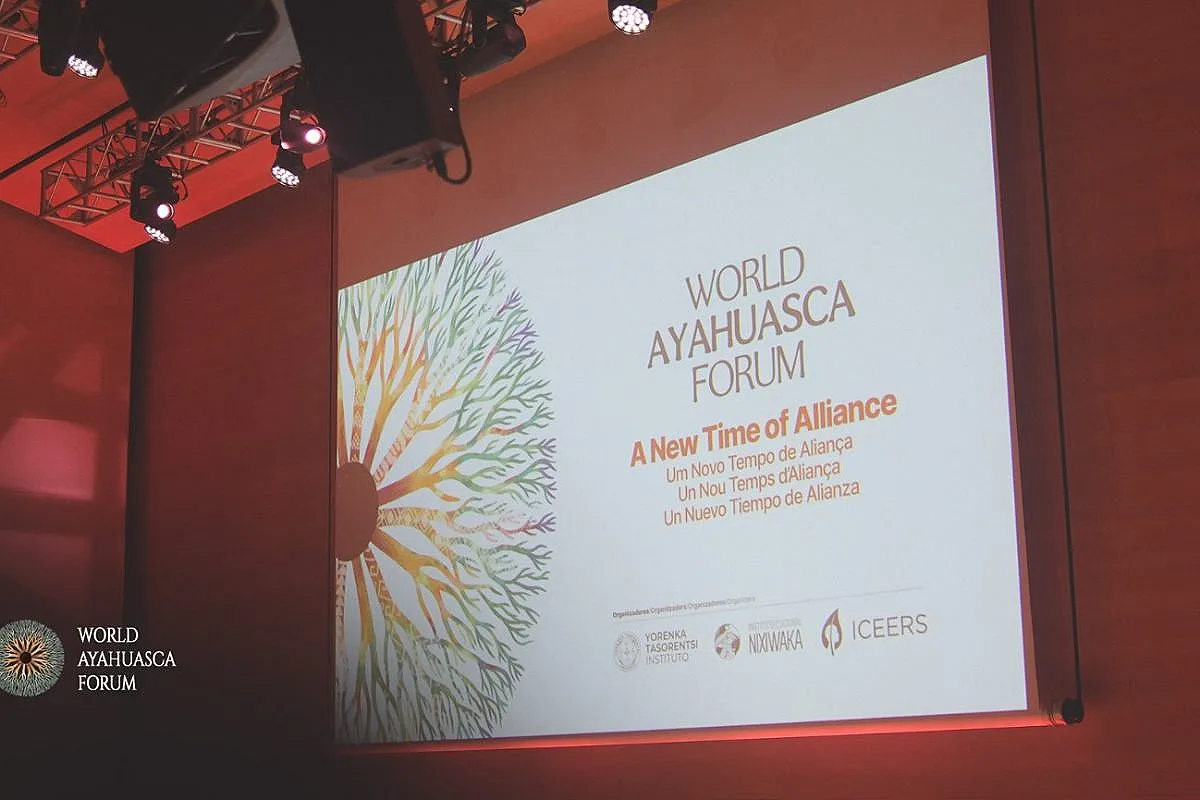
The World Ayahuasca Forum (WAF) took place in Girona, Catalonia, from 11–13 September 2026, bringing together Indigenous wisdom keepers, ayahuasqueros, padrinhos, medicine makers, curanderos, pajés, advocates, conservationists, researchers, practitioners, artists, investors, policymakers, lawyers, and many others working across the global ayahuasca field. “Ayahuasca” is itself an umbrella term and only one name among many for this medicine: it is known as yagé among the Cofán, Siona and Tukano peoples, as oni among the Shipibo, and as uni or huni among the Huni Kuin, among others. The gathering of over 1,700 people was put on by ICEERS (International Center for Ethnobotanical Education, Research and Service), Yorenka Tasorentso Institute, and Instituto Cultural Nixiwaka, alongside many sponsors and community partners. Its programme included conversations on Indigenous sciences, globalisation, Indigenous rights, intellectual property, safety, integration, territory and sovereignty. It should not be lost on any of us that the gathering was held in Catalonia, a region with its own distinct language, culture and history, which made it a meaningful setting for conversations about territory, identity and sovereignty.
I had the privilege of speaking on the panel “Global Expansion: Critical Perspectives”, alongside Dr. Geoff Bathje (psychologist and co-founder of the Sana Healing Collective), Dr. Ariel Richer (assistant professor at the University of Utah College of Social Work and co-founder of the Urban Indigenous Collective), Benoit Azagoh-Kouadio and Jose Santiago Sanchez Roca. My contribution was titled “From Pilgrimage to Re-Rooting: Ayahuasca, Biocultural Responsibility, and the Ethics of Coming Home.”
I opened the panel with an invitation to breathe together and a question: If we believe psychedelic experiences can increase our sense of connection, what then happens when we return to the lives, communities and systems we came from? And perhaps more specifically, what does that question ask of those of us who work with people before, during and after altered-state experiences?

1. Integration cannot only mean making sense of an experience
“Psychedelic integration” is now a familiar term, but there is still variation in what practitioners mean by it and how they implement it. In a small qualitative study of 41 Western participants in facilitated group ayahuasca ceremonies, Bathje et al. found that participants reported a wide range of lasting shifts, from mental health benefits to an increased sense of connection to nature, spirituality and a larger concern for the greater good. These findings are self-reported, and a few participants also described problematic experiences, including possible hallucinogen persisting perception disorder (HPPD) and sexual assault during an ayahuasca retreat. This serves as a pertinent reminder that safe settings, good support and strong ethics matter wherever these experiences take place, including in ceremonial spaces. A review by Watts and Luoma found substantial diversity in definitions, practices and models of psychedelic integration, specifically for psychedelic assisted therapy (PAT), while more recent work has continued to call for clearer, evidence-informed approaches.
Uncertainty or variability is not necessarily the problem here. In fact this may be our path forward. Psychedelic experiences happen in very different contexts, and people need different kinds of support. There is a poignant question underneath the terminology shared by Loures de Assis et al.: What are we actually integrating someone into?
Integration can become narrowly individualised. We process the experience, and are invited to journal. We may talk about close relationships and identify insights. We establish routines and identify possible shifts. We perhaps work with a therapist or coach to support us in this container. All of this can be incredibly meaningful. But human beings do not exist outside of relationships, communities, economies, political systems and ecosystems. An experience may be deeply personal without being exclusively personal.
This understanding shines brightly like the stars in a rural sky, particularly when we are working with plant medicines whose histories and contemporary use are inseparable from particular peoples, territories and living biocultures. The WAF itself was structured around this wider context, with sessions addressing Indigenous biocultures, ancestral knowledge, territory, sovereignty, intellectual property, policy and biocultural responsibility alongside the more familiar conversations about safety and integration.
For practitioners, this creates an uncomfortable but important possibility: perhaps integration sometimes needs to move beyond the question “What did this experience mean to you?” and towards “How will this experience change how you participate in the world?”
2. From pilgrimage to relationship
Some people encounter ayahuasca through a form of pilgrimage, even an accidental one like myself. They travel somewhere and enter a community or ceremonial context that is different from their own. They encounter a medicine with histories much older and broader than contemporary Western psychedelic culture. While there can be enormous value in that journey, there can also be ethical complexity.
Ayahuasca has globalised tremendously beyond its Amazonian origins, becoming part of religious, therapeutic, spiritual and personal practices in many parts of the world. Scholars have long examined the implications of this globalisation, including questions of harm reduction, legal status and the ways ayahuasca is socially constructed outside the contexts in which it originated.
The WAF explicitly positioned itself within these questions. Its organisers described the gathering as an Indigenous-led space concerned with ethics, regulation, research, biocultural rights and the challenges created by globalisation. For me, the question is not whether people should travel to work with ayahuasca. Of course, it is not my place to tell someone that their relationship with a medicine is right or wrong. The more interesting question is what happens afterwards. What then will they be and do? If a person travels across the world to encounter a medicine and a community, what relationships do they carry home? Does the journey end when the plane lands? Or does that return become part of the work?
3. Integration into what?
This is the question I keep coming back to. Integration into what? If someone has an extraordinary experience of interconnectedness but returns to profound isolation, is the work finished? Or has it only just begun? If someone experiences a renewed sense of responsibility towards the living world but has no relationship with the land immediately around them, where might that responsibility begin? If someone speaks about reciprocity in ceremony but continues participating in extractive relationships without examining them, what does integration ask us to notice? These are not questions with a single correct answer. They are invitations to widen the frame.
Research is beginning to take community and ritual more seriously in psychedelic contexts. A 2025 study of group-based psychedelic-assisted therapy, for example, examined social connectedness and therapeutic community, rather than treating the psychedelic experience as an exclusively individual phenomenon. Other researchers have explored community and belonging as meaningful dimensions of psychedelic work. Of course, none of this is new. For the Indigenous peoples who have worked with these medicines for generations, community and ceremony have always been at the centre of the practice, a continuity that Loures de Assis et al. argue the “psychedelic renaissance” framing erases.
A 2026 systematic review also found that community-engaged research remains uncommon in psychedelic-assisted therapy research: only three of 27 US clinical trials reviewed incorporated community-engaged research practices. There is therefore an interesting parallel. We are increasingly interested in connection as an outcome of psychedelic experiences, while many of the structures surrounding psychedelic practice remain highly individualised. I believe that one task for practitioners is to help close that gap.
4. Place is part of the story
One of the most profound forms of integration can be deceptively ordinary: Where are you? Not spiritually or even geographically. What land are you living on? What histories shaped it? Who lived there before you? Who lives there now? What waters run through it? What species are your neighbours? What are the political and ecological struggles happening around you? What does your community need? These questions can feel very far away from psychedelic practice. I increasingly believe they are not.
The WAF’s own framing emphasised the protection of biocultural traditions, ecosystems and territories. Its organisers have described the choice to hold the gathering in Europe as an attempt to re-signify and disrupt colonial routes of knowledge exchange and bring Indigenous perspectives into dialogue with institutions and audiences beyond the Amazon. Naturally, that raises an important challenge for practitioners. If our work is about helping people become more connected, we should be curious about the places in which that connection might become tangible.
In this way, integration might mean joining or starting a community garden, or learning the local ecological and peoples’ history. Attending a neighbourhood meeting or supporting a local mutual-aid project. It definitely could mean learning whose traditional territory you live on, as well as building relationships with people who do not participate in psychedelic culture. Paying attention to local political decisions that affect housing, public health, drug policy or environmental protection. These actions are not replacements for therapy, reflection or spiritual practice. They are examples of where an internal shift can become relational, as the practice.
5. Practitioners cannot integrate someone else’s life for them
There is also a boundary here that I think is essential. A practitioner does not get to decide what another person’s integration should look like. We should be careful not to turn integration into another form of prescription. The role may instead be to create enough space for a person to ask better questions. What did you notice? What changed? What relationships are asking for your attention? What responsibilities became clearer? What feels different about your relationship with your home? What would it mean to live this rather than simply understand it? What would reciprocity look like in your actual circumstances? This is especially important because psychedelic work already carries significant power dynamics. Practitioners may be perceived as knowledgeable, spiritually authoritative or unusually connected to something the client wants.
Practitioners, whether coaches or therapists, have a crucial role here too, working within frameworks that can be inherently colonising. What work must we do to decolonise the way we think about our relationships with clients, and our own minds in the process?
The answer is not to become another person telling clients how to live. It is to become better at supporting agency. That may sometimes mean helping someone discover that their next step has nothing to do with yet another ceremony.
6. Coming home can be its own practice
For me, re-rooting has become a useful way of thinking about this. The goal is not necessarily to stop travelling. It is not to reject ayahuasca, pilgrimage or cross-cultural learning by any means. It is to notice that relationship can deepen through return. The WAF described itself as a space for alliance, reciprocity and intercultural dialogue, with Indigenous leadership at the centre. If we take those principles seriously, perhaps practitioners can ask a similar question of our own work. Where are we rooted? Who are we accountable to? What communities do we belong to? What communities are affected by our work? What knowledge are we receiving? What are we giving back? And perhaps most importantly: What happens when the extraordinary experience becomes an ordinary Tuesday? When the ceremony ends, the insight fades, and the integration session finishes. The person still has to go home. That home is not an interruption to the psychedelic experience but where the experience has the opportunity to become a relationship, a practice and, potentially, a responsibility.
7. Conclusion: connection as a practice
Let me be as clear as I can: you do not have to drink ayahuasca to feel a responsibility to care for the earth and its people. The WAF was not about whether people should seek altered-state experiences. It inspired conviction towards a path together that centres care, connection, and resistance to the dominant paradigm.
Yes, the work of integration may begin with the individual, but it does not end there. For practitioners, this creates an opportunity to widen our understanding of care. We can make room for body, psyche, relationship, community and place without assuming that every client needs the same path. We can ask better questions and actually listen to the answers. We can acknowledge and protect the Indigenous biocultures from which many contemporary psychedelic practices have emerged. And we can remember that connection is not only a feeling.
It truly is a practice. Sometimes it looks like sitting with an experience. Sometimes it looks like repairing a relationship, or learning the history of the place where you live. Oftentimes integration looks surprisingly ordinary and dare I say human: becoming a member of your own community. Coming home is not the end of the pilgrimage. It is where another kind of relationship begins.
References
Bathje, G. J., Fenton, J., Pillersdorf, D., & Hill, L. C. (2024). A qualitative study of intention and impact of ayahuasca use by Westerners. Journal of Humanistic Psychology, 64(4), 653. https://doi.org/10.1177/00221678211008331
Dorsen, C., Noero, L., Knapp, M., Arden, K., & Rosa, W. E. (2025). Cosmology of belonging: The role of community in the therapeutic use of psychedelics. Palliative & Supportive Care, 23, e27. https://doi.org/10.1017/S1478951524001688
ICEERS. (2026, March 24). Indigenous peoples speak out on the future of ayahuasca. https://www.iceers.org/en/news/indigenous-peoples-speak-out-future-ayahuasca/
Labate, B. C., & Cavnar, C. (Eds.). (2018). The expanding world ayahuasca diaspora: Appropriation, integration and legislation. Routledge.
Loures de Assis, G., Omágua Kambeba, A., Lima, J., De Bortoli, C., Montgomery, C., Ruffell, S., & Rodrigues, J. (2026). From renaissance to confluence: A call for paradigm shift in psychedelic studies. Psychedelics, 3, 100010. https://doi.org/10.1016/j.psyche.2026.100010
Native Land Digital. (n.d.). Native Land [Interactive map]. https://native-land.ca/
Reid, M., Song, J., Boehnke, K. F., Buchanan, N. T., & Aday, J. S. (2026). Disengaged: A systematic review of community engagement in psychedelic-assisted therapy research. Neuroscience & Biobehavioral Reviews, 106516. https://doi.org/10.1016/j.neubiorev.2025.106516
Rose, J. R. (2025). From isolation to social (and psychedelic) integration: A sociology of collective effervescence and therapeutic community in psychedelic-assisted therapy. Sociology of Health & Illness, 47(1), e13872. https://doi.org/10.1111/1467-9566.13872
Vucak, N., Bruno, R., Quealy, J., Casimaty, J. G., Rossell, S. L., Castle, D. J., & Acevedo, N. (2026). Integration in classic psychedelic-assisted therapies for mental health conditions: A scoping review. Psychedelics, 4, 100030. https://doi.org/10.1016/j.psyche.2026.100030
Watts, R., & Luoma, J. B. (2020). The use of the psychological flexibility model to support psychedelic assisted therapy. Journal of Contextual Behavioral Science, 15, 92–102.
World Ayahuasca Forum. (2026). World Ayahuasca Forum 2026. https://www.ayahuasca2026.com/
World Ayahuasca Forum. (n.d.). Press release. https://www.ayahuasca2026.com/press-release/
Image source: www.universomultidisciplinart.com